



From our family to yours
Leave your email and receive exclusive content
CO₂ Sensors: how they work and why they are transforming air renewal
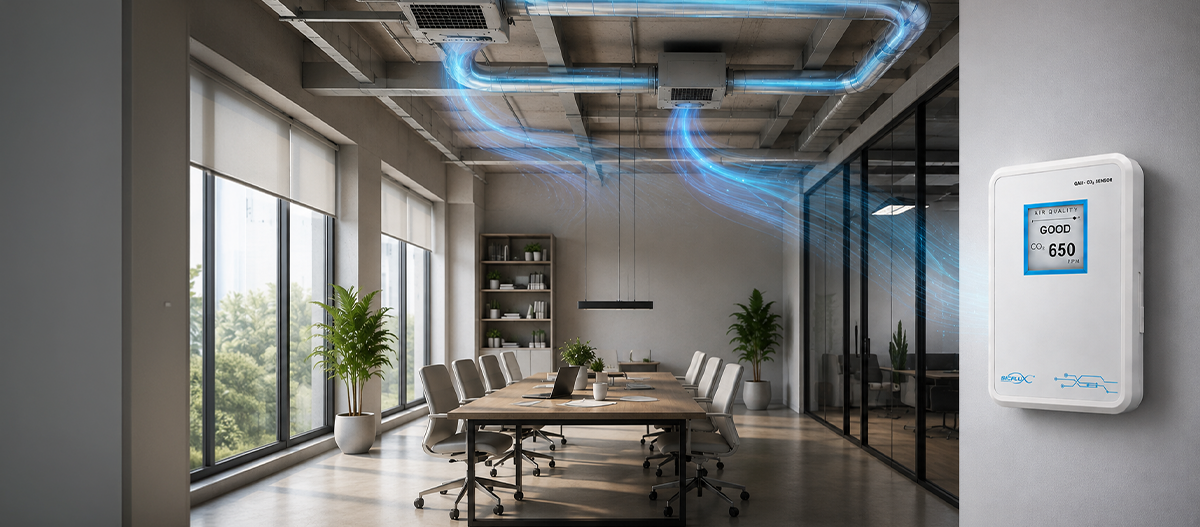
CO₂ sensors are changing the way commercial buildings, healthcare facilities, schools, and industrial sites manage indoor air quality. Instead of operating ventilation systems at a constant rate, these sensors allow fresh air ventilation to adjust according to actual occupancy.
As a result, buildings improve energy efficiency, enhance occupant comfort, and maintain appropriate indoor air quality.
What do CO₂ sensors measure?
Carbon dioxide (CO₂) is naturally released through human respiration. In enclosed spaces, its concentration increases as the number of occupants and the duration of occupancy grow.
For this reason, CO₂ is one of the primary indicators used to assess ventilation effectiveness. Rising CO₂ levels indicate that additional outdoor air is needed to maintain healthy indoor conditions.
Continuous monitoring also allows ventilation systems to quickly detect changes in occupancy, enabling automatic and highly efficient operation.
How do CO₂ sensors work?
CO₂ sensors continuously monitor the concentration of carbon dioxide in the indoor environment. This information is then transmitted to a building automation system, or ventilation controller.
As occupancy increases, the system automatically increases the amount of outdoor air supplied to the space. Likewise, when occupancy decreases, ventilation rates can be reduced to avoid unnecessary energy consumption while maintaining appropriate indoor air quality.
This approach is known as Demand-Controlled Ventilation (DCV) and has become a standard.
Beyond CO₂: a complete indoor air quality strategy
Although CO₂ is an excellent indicator of ventilation demand, it is only one component of indoor air quality.
Many modern HVAC systems combine multiple sensors to monitor several environmental parameters simultaneously, including:
- CO₂
- Carbon monoxide (CO)
- Temperature
- Relative humidity
- Particulate matter (PM2.5 and PM10)
By combining these measurements, building automation systems can make more informed decisions, improving occupant safety, indoor comfort, and overall system performance.
Sicflux Sensors: intelligent monitoring for healthier buildings
Sicflux offers complete indoor air quality monitoring solutions, including its CO₂ Sensor for controlling air renewal according to occupancy.
The product line also includes CO sensors for monitoring carbon monoxide concentrations in applications such as underground parking facilities, and other environments where combustion gases may accumulate.
Integrated with Sicflux automation systems, these sensors enable intelligent ventilation, increasing safety, reducing energy waste, and improving overall energy efficiency.
Why use CO₂ sensors for air renewal?
Key advantages include:
- Improved indoor air quality.
- Greater occupant comfort.
- Reduced energy consumption.
- Real-time, data-driven operation.
- Higher HVAC system efficiency.
- Compliance with smart building practices.
Continuous monitoring allows the system to respond quickly to occupancy changes, ensuring ventilation operates only when necessary.
The future of air renewal is intelligent
The demand for healthier indoor environments makes CO₂ sensors increasingly important in modern projects. Combined with automation, they improve ventilation efficiency, reduce operating costs, and increase occupant safety.
At Sicflux, smart sensors and control systems work together to transform data into automatic decisions, ensuring every environment receives exactly the amount of fresh air it needs.


Receive exclusive content for free
Comentários