



From our family to yours
Leave your email and receive exclusive content
Radial and axial fans: differences, applications, and selection criteria
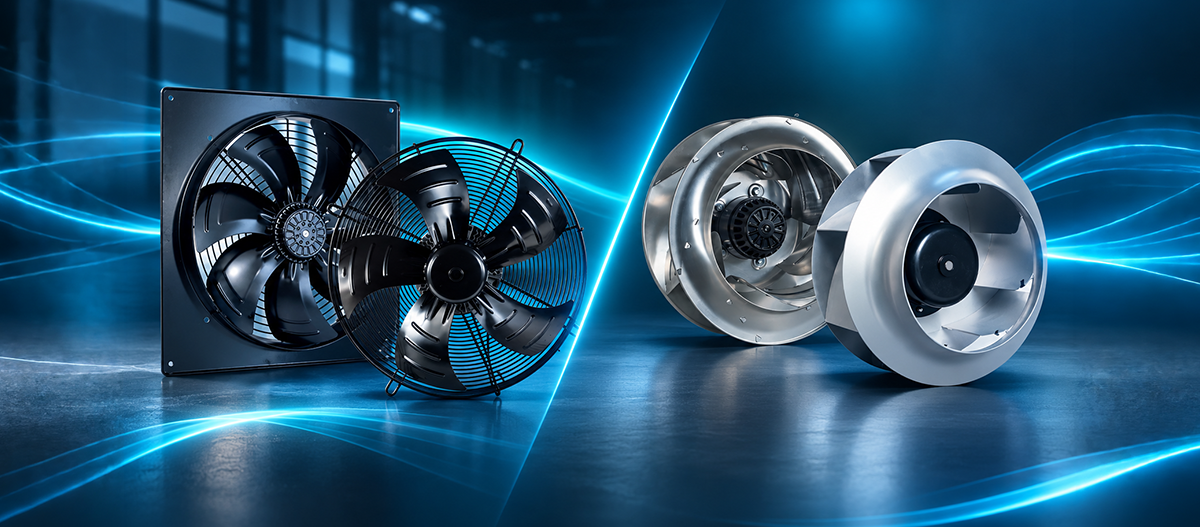
Radial and axial fans meet different air-movement needs in commercial and industrial systems. Although both play important roles in ventilation, their operating characteristics affect airflow, static pressure, and installation requirements. Understanding these differences is therefore essential to specifying a solution that fits each project.
What is the difference between radial and axial fans?
The main difference is the direction of airflow in relation to the axis of rotation. In axial fans, air passes through the impeller primarily along the axis. This configuration favors high airflow at moderate pressure, which is why it is used in a wide range of ventilation and cooling applications.
Radial fans, also known as centrifugal fans, direct air outward from the impeller in a radial direction. Depending on the model and its design characteristics, this configuration can serve systems that require different pressure conditions. However, choosing between radial and axial fans based on operating principle alone is not enough. Each unit has a performance curve that should guide the selection process.
Where are radial and axial fans used?
Applications vary according to the characteristics of each model. Radial fans can be used in supply and exhaust systems, precision air conditioners, fan coil units, and compact air-handling units.
Axial fans, on the other hand, are used in industrial ventilation, commercial and industrial cooling, air conditioning, and thermal management of electronic components. In addition, different design configurations and motor options broaden the possible applications of these technologies.
What criteria should be considered when selecting a fan?
AnBefore choosing the equipment, it is necessary to understand the system’s operating conditions. The main criteria include:
- Airflow: the amount of air required for the application.
- Static pressure: the fan’s ability to overcome system resistance.
- Installation conditions: available space, positioning, and integration with other components.
- Design characteristics: materials, dimensions, and motor type.
- Operating conditions: specific operating and performance requirements.
In addition, ducts, connections, and accessories can affect pressure losses. Therefore, sizing must account for the entire installation, not just the fan.
How does the Falcon line serve different applications?
Sicflux’s Falcon Radial and Axial line includes models for different air-movement requirements. Depending on the model, available features include ultra-compact housings, direct drive, ball bearings, and AC and EC motor options.
Likewise, the units feature different construction materials and performance parameters. Selection should therefore be based on the technical specifications of each version.
Specification starts with the project’s needs
Choosing between radial and axial fans involves more than comparing shapes. Airflow, pressure, installation, and operating conditions all directly affect whether the equipment is suitable.
Are you developing a ventilation project? Contact the Sicflux team for technical support in identifying the solution best suited to your application. Get in touch.


Receive exclusive content for free
Comentários