



From our family to yours
Leave your email and receive exclusive content
Demand-controlled ventilation: less energy consumption, greater efficiency
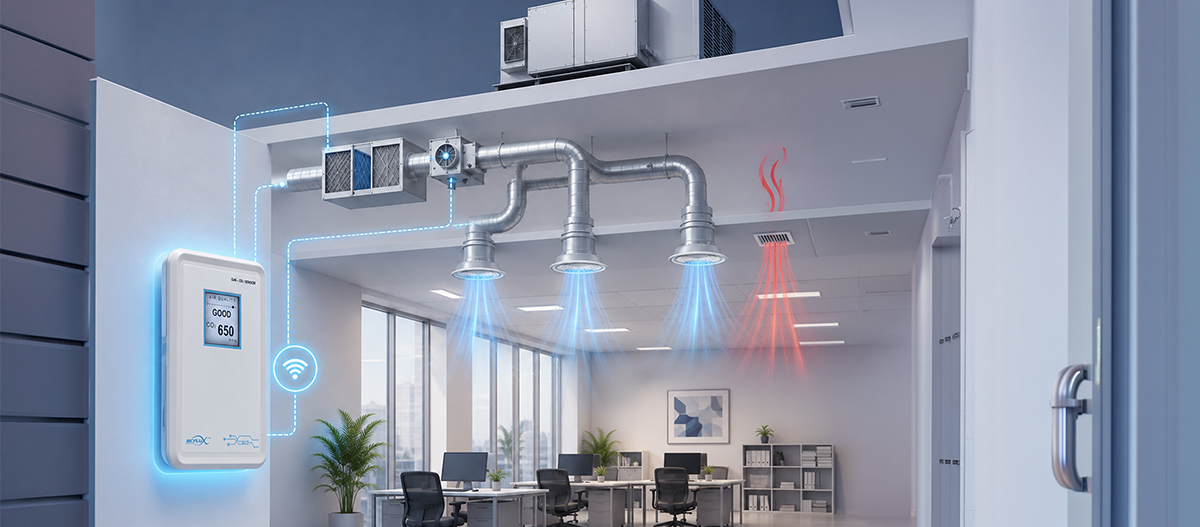
Demand-controlled ventilation is transforming the way buildings manage indoor air quality and energy consumption. Instead of keeping running continuously at the same speed, this technology automatically adjusts air renewal according to the actual needs of each environment.
As a result, companies reduce operating costs, improve HVAC-R system efficiency, and provide greater comfort for occupants. In addition, operation becomes smarter because every decision is based on real-time environment data.
What is demand-controlled ventilation?
Demand-controlled ventilation is an automation strategy that regulates airflow according to environmental conditions. Unlike conventional systems, it uses sensors to monitor occupancy, CO₂ concentration, temperature, humidity, and, in certain applications, carbon monoxide (CO).
When occupancy increases, the system raises the air renewal rate. When fewer people are present, ventilation is automatically reduced. In this way, energy consumption matches the building’s actual needs.
How does it work?
The system integrates sensors, controllers, and ventilation equipment. Sensors continuously monitor indoor conditions, and this information is sent to the automation system, which adjusts fan speed or activates additional equipment whenever necessary.
This process is automatic and continuous, preventing both energy waste and insufficient air renewal. Data-driven operation also increases system reliability and reduces the need for manual intervention.
What are the benefits?
- Reduced electricity consumption.
- Improved HVAC-R system efficiency.
- Improved Indoor Air Quality (IAQ).
- Reduced equipment wear.
- Lower maintenance costs.
- Greater occupant comfort.
- Intelligent automated operation.
Consequently, demand-controlled ventilation contributes to more sustainable buildings that meet today’s energy efficiency requirements.
Smart sensors make all the difference
Proper environmental monitoring is essential. A CO₂ sensor continuously measures carbon dioxide concentration and indicates when air renewal should be increased in occupied spaces.
A CO sensor monitors carbon monoxide in parking garages and other areas with vehicle traffic, allowing ventilation to operate only when necessary.
Automation for more efficient ventilation
Efficiency increases when sensors and equipment work together. Solutions such as the Sicflux System Grill automate air renewal control and enable rapid responses to changing environmental conditions.
As a result, ventilation no longer operates on fixed schedules but according to the real needs of each space, providing a more economical, safer, and more efficient operation.
Learn more about Sicflux System Grill
The future of ventilation is intelligent
Demand-controlled ventilation represents an evolution in indoor environmental management. By combining smart sensors, automation, and high-efficiency equipment, it reduces energy consumption without compromising indoor air quality.
At Sicflux, technology and innovation go hand in hand to develop solutions that make buildings healthier, more efficient, and ready for the challenges of the future.

Receive exclusive content for free
Comentários