



From our family to yours
Leave your email and receive exclusive content
Smart parking garage ventilation: how sensors and induction fans work together
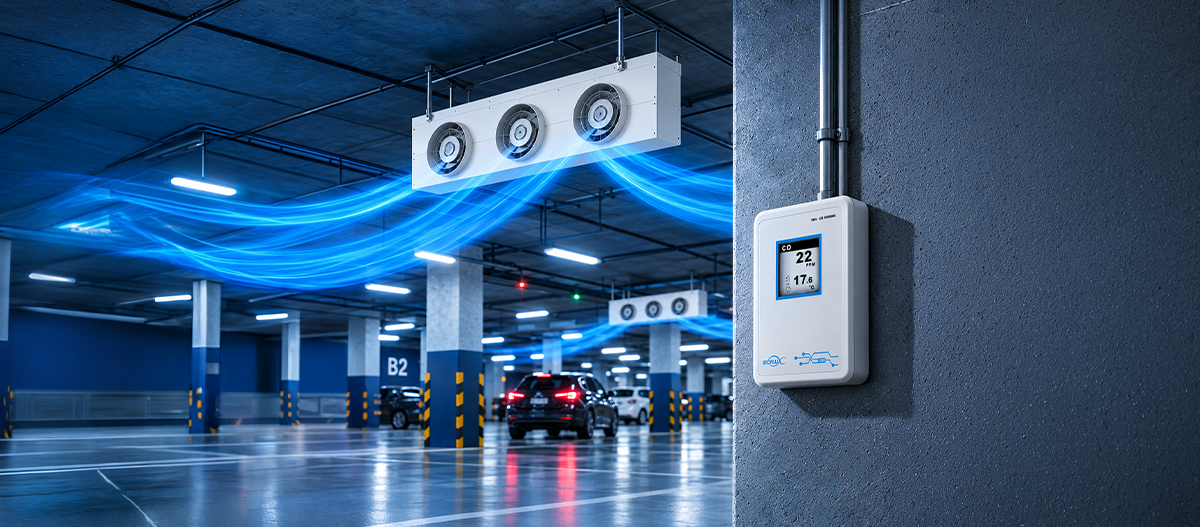
Smart parking garage ventilation is based on a simple idea: environmental conditions are not the same throughout the day. Some periods experience heavy vehicle traffic, while others have very little movement. That’s why a ventilation system can take into account what is actually happening in the space to determine how it operates.
In this context, sensors, control systems, and induction fans can work together as an integrated system. Each component plays a role in a strategy that connects monitoring, activation, and airflow.
The first step is understanding the environment
Not everything present in the air can be detected by people. Carbon monoxide (CO), for example, has no color or smell. That’s why monitoring plays an important role. Sensors track the parameters established for the application and provide information about environmental conditions.
This means the system does not rely solely on visible activity in the parking garage. It also uses data to guide the ventilation strategy.
How do sensors connect to ventilation?
Monitoring is the first step. The information collected must then trigger a response. When the monitored parameters reach the conditions established in the design, the control system can activate ventilation according to the operating logic defined for that application.
The process can be understood in simple terms: monitor → identify → control → ventilate.
This allows system operation to adapt to changing parking garage conditions throughout the day instead of treating every moment as if it were the same.
What role do induction fans play?
Once the system identifies the need for ventilation, airflow must be promoted. Induction fans, also known as Jet Fans, generate directed airflow within the parking garage. This helps move air and guide pollutants toward the exhaust points specified in the design.
Depending on the installation’s characteristics and sizing, this strategy may also reduce the need for extensive ductwork, making better use of the available space.
Why invest in smart parking garage ventilation?
Smart parking garage ventilation does not depend on a single piece of equipment. Its key advantage lies in the integration of different components. The sensor monitors. The control system receives and interprets the information. The ventilation equipment operates according to the established strategy.
This integration makes it possible to develop a system that responds to environmental conditions and uses data to guide its operation. After all, if parking garage conditions change throughout the day, it makes sense for the ventilation strategy to account for those changes.
Want to learn how sensors, control systems, and induction fans can work together in your project? Explore Sicflux solutions for parking garage ventilation and get in touch with our technical team.


Receive exclusive content for free
Comentários